

LAPG Research Project: Non-Chargeable Time in Legal Aid Work
The project
LAPG conducted a research project in an effort to capture the amount of time spent on non-chargeable tasks generated by undertaking casework and operating under a legal aid contract – so both casework and non-casework tasks. These tasks can be many and varied taking differing amounts of time. Some are conducted daily, some weekly and others less frequently, such as file reviews and audits.
The overarching aim of the project was to compile robust empirical data on hidden or ‘non-chargeable’ costs of doing legal aid work, in order to influence policy in relation to legal aid funding and the operation of the scheme. We had three research objectives:
- Identify and quantify ‘hidden’ but unavoidable costs associated with legal aid contracts.
- Analyse what tasks are intrinsically linked to the proper management of casework but are not currently claimable time in the Cost Assessment Guidance and Criminal Bills Assessment Manual.
- Evaluate the complexity of the funding scheme and contractual framework and identify elements that may create complexity without adequate justification. This may include identifying of duplication of tasks required by legal aid contracts and regulatory or quality assurance requirements.
The Findings
The study involved 84 employees working for 10 legal aid organisations. Dr Jo Wilding, Associate Professor in Law at the University of Sussex, analysed the data and produced a report which found that:
- legal aid organisations undertake a significant amount of unpaid work – the average amount of time spent on non-chargeable tasks was just over one hour and 43 minutes per day, which is around one quarter of a standard 7 hour working day for each employee
- These tasks are not optional – they must be undertaken to maintain legal aid contracts and to support clients – but practitioners cannot bill for them
- Some tasks generate a significant proportion of this ‘hidden time’, such as means testing, new client enquiries, billing processes, dealing with formal contact with the LAA and auditing requirements
- The combined burden of the various unpaid tasks means that legal aid practitioners are effectively subsidising the state-funded legal aid scheme. The scheme relies on cross-subsidisation, unpaid labour and overtime, raising significant concerns about financial sustainability and the wellbeing of the legal aid workforce

Next Steps
LAPG has provided the Ministry of Justice and the Legal Aid Agency with a copy of the report and invited both bodies to explore three potential solutions to this completely unsustainable situation:
- increasing fees so that chargeable time is better able to subsidise the non-chargeable time;
- amending guidance so that practitioners can claim for the work actually carried out to deliver legal aid services;
- reviewing, amending or even removing processes to reduce the administrative burden on providers.
In recent years the Ministry of Justice has carried out extensive reviews of both criminal and civil legal aid, and the legal aid means test. Along with a significant body of data and evidence produced by external bodies such as LAPG and The Law Society, the government is now in an ideal position to implement reforms to improve the legal aid scheme.
We have been encouraged by the Minister’s recently stated ambition to ‘rebuild a more stable and sustainable legal aid sector’. We therefore call on the government to work with us to create a system that reduces the burden on practitioners and enables them to spend more of their time supporting clients.
The Legal Aid Census Report
March 2022
Unique research tells the story of legal aid lawyers across England and Wales -from entry to the profession, throughout their careers and beyond. As legal aid deserts spread throughout the country this first comprehensive picture of the sector also charts the health and sustainability of the organisations providing legal advice on the frontline.
There is a widely acknowledged lack of data to inform legal aid policy-making which has been a problem for many years. It is our hope that this data will form the baseline for policy-making around access to justice for years to come and that the Ministry of Justice will build upon this research and conduct further research of its own into the sustainability of the legal aid sector.
The Census was devised by independent legal academics from Glasgow School of Law and Cardiff University and launched in April 2021. It closed on 11 June with such a surfeit of quantitative and qualitative data that the team expanded with additional researchers from Monash University and the University of Oxford.
The Census demonstrates that practitioners are highly motivated and committed to their clients and to social justice. However, a lack of investment has caused significant issues across the legal aid sector, including:
- Considerable barriers for those seeking to enter the profession – from limited training opportunities to high levels of student debt that cannot be serviced by low salaries – this is creating a recruitment crisis across the sector
- Difficulties in retaining staff due to low salaries, a lack of career progression and a range of issues impacting adversely on staff wellbeing
- Fixed fees and hourly rates are too low and fail to reflect the complexity of the work, the vulnerabilities of clients, and the time taken to provide the services that clients require, leading practitioners to do unpaid work, work far longer than they are remunerated for and limiting the type of cases that can be taken on
Joint Open Letter to the Lord Chancellor
We are today launching a campaign seeking greater investment in legal aid. The Census data, Westminster Commission report, Justice Committee report, Criminal Defence Data Compendium, Law Society advice desert maps, and Independent Criminal Legal Aid Review all provide the government with incontrovertible evidence that the legal aid sector is crisis. Indeed, the government’s own data (scant that it is) demonstrates a steady decline in both crime and civil provider numbers and a reduction in capacity across the whole sector, pointing to a sustainability crisis caused by decades of under-investment in legal aid. Crucially, this also equates to an access to justice crisis, with hundreds of thousands of people each year unable to get the advice and representation the need and deserve.
We have published an Open Letter to the Lord Chancellor, supported so far by 11 other sector bodies, calling on the government to:
Establish an expert advisory panel to conduct further research on access to justice and sector sustainability, to inform future government policy on all aspects of legal aid
Commit to an immediate increase in civil and criminal legal aid fees, accounting for historical inflation, and index-linked in the future to ensure that fees increase in line with the cost of delivering services
Give more people the opportunity to forge a career in legal aid through, for example, a return to government-funded training and qualification processes for both civil and criminal areas of law
Signature bodies
Jenny Beck QC (Hon) and Nicola Mackintosh QC (Hon), Co-Chairs, Legal Aid Practitioners Group
Chilli Reid, Executive Director, AdviceUK
Jack Ridgway, Vice Chairman, Association of Costs Lawyers
Cris McCurley, Vice President, FIDA UK (International Federation of Women Lawyers)
Simon Mullings, Co-Chair, Housing Law Practitioners Association
Julie Bishop, Director, Law Centres Network
Suzanna Eames, Chair of The Law Society of England & Wales’ Junior Lawyers Division
Sue James, Director, Legal Action Group
Jo Hickman, Director, Public Law Project
Emma Cordock, Co-Chair of the Legal Aid Committee, Resolution
Catherine Atkinson, Chair, Society of Labour Lawyers
Kaya Kannan and Paige Jones, Co-Chairs, Young Legal Aid Lawyers

The Legal Aid Census
An opportunity for the legal aid sector to come together, demonstrate the incredible impact of legal aid and convince policy-makers of what needs to be done to save legal aid and access to the justice system.
Launched on 12 April 2021, the Legal Aid Census brought together an independent team of academics from Newcastle, Cardiff and UCL universities to work alongside our staff and Advisory Committee of experienced, expert legal aid practitioners. It aims to influence government policy by gathering robust, irrefutable evidence about the state of the legal aid profession and to make evidence-based recommendations to ensure it is viable and sustainable.
Information on legal aid providers has been scant since the Legal Services Research Centre was closed in 2013. It is difficult to find accurate, comparative data from earlier periods and what data we do have tells us very little about the viability of the sector. We know very little else about the legal aid ecosystem and how it relates to the justice system as a whole. In order for future reform to be evidence-based, we need data from each and every provider and organisation.
The Legal Aid Census has been in the planning for over a year. The data that we gathered is currently being analysed and the report will be published in the autumn in time to feed into Sir Christopher Bellamy’s Independent Review of Criminal Legal Aid. This research is also closely aligned to the Westminster Commission Inquiry into the Sustainability of Legal Aid co-ordinated by the APPG.
We are using the following hashtags #WeAreLegalAid #LegalAidCensus and #StrengthInNumbers to promote the work across social media.
The research has garnered a huge amount of support across the sector, with signatories including the Criminal Bar Association, The Bar Council and Shelter signing up to a joint open letter.
The Census closed on 11 June 2021 and the independent academic panel reported in September 2021.
2200+ responses obtained (with 200 so far on the student census)
We’ve created a FAQ document to explain the research, our methodology and ethical/GDPR approach and how to raise questions or concerns about the survey.

Joint Open Letter to the Sector
Dear Members of the Legal Aid Community,
We know the crisis in legal aid is real – but we need your help to prove it.
As Government navigates the worst recession on record, we are determined that justice must not be an afterthought. Our organisations represent those on the legal aid frontline and we are calling for every practitioner working in publicly funded law to take part in the 2021 Legal Aid Census. We are asking every solicitor, barrister, legal executive, paralegal, caseworker, practice manager and those looking to enter the profession (and those who have already left it) to stand up and be counted.
We are asking you to give us just a few minutes of your time to take part in this unique survey, which will help shape legal aid policy for years – possibly decades – to come.
We all know that the crisis with legal aid did not start with the pandemic – and it won’t end with it, either. Successive governments have failed to address existing problems in the justice system, as years of cuts and underfunding take their toll. There are now just over 2000 organisations across England and Wales with a legal aid contract – a massive reduction in client access in the last decade – and this erosion of access to justice shows no sign of waning.
That is why we are asking for your support to provide the detailed, robust evidence we need to show the current financial and emotional health of the organisations and individuals doing this vital work.
You can access the Legal Aid Census here
Legal Aid Census data will be analysed over the summer and the findings published in the autumn in time for the Treasury Spending Review and to feed into both Sir Christopher Bellamy’s Independent Review of Criminal Legal Aid, and the Westminster Commission Inquiry into the Sustainability of Legal Aid, co-ordinated by the APPG on Legal Aid.
We know there can be no ‘levelling up’ in this country without a properly funded, sustainable justice system. That is why we, the undersigned, are urging you all to take part in LAPG’s unique Legal Aid Census, so we can make the strongest possible case to government of the need for urgent reform of legal aid.
Yours sincerely,

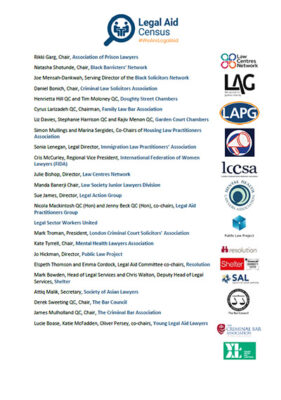
Chilli Reid, Executive Director, AdviceUK
Claire Green, Chair, Association of Cost Lawyers
Hannah Perry and Siobhan Kelly, co-chairs, Association of Lawyers for Children
Rikki Garg, Chair, Association of Prison Lawyers
Natasha Shotunde, Chair, Black Barristers’ Network
Joe Mensah-Dankwah, Serving Director of the Black Solicitors Network
Daniel Bonich, Chair, Criminal Law Solicitors Association
Henrietta Hill QC and Tim Moloney QC, Doughty Street Chambers
Cyrus Larizadeh QC, Chairman, Family Law Bar Association
Liz Davies, Stephanie Harrison QC and Rajiv Menon QC, Garden Court Chambers
Simon Mullings and Marina Sergides, Co-Chairs of Housing Law Practitioners Association
Sonia Lenegan, Legal Director, Immigration Law Practitioners’ Association
Cris McCurley, Regional Vice President, International Federation of Women Lawyers (FIDA)
Julie Bishop, Director, Law Centres Network
Manda Banerji Chair, Law Society Junior Lawyers Division
Sue James, Director, Legal Action Group
Nicola Mackintosh QC (Hon) and Jenny Beck QC (Hon), co-chairs, Legal Aid Practitioners Group
Legal Sector Workers United
Khristian Khan, Chief Executive, and Gerald Rivett, Chairman, Liverpool Community Advice
Mark Troman, President, London Criminal Court Solicitors’ Association
Philippa Kaufmann QC, Chair of the Management Committee, Matrix Chambers
Kate Tyrrell, Chair, Mental Health Lawyers Association
Jo Hickman, Director, Public Law Project
Elspeth Thomson and Emma Cordock, Legal Aid Committee co-chairs, Resolution
Mark Bowden, Head of Legal Services and Chris Walton, Deputy Head of Legal Services, Shelter
Attiq Malik, Secretary, Society of Asian Lawyers
Derek Sweeting QC, Chair, The Bar Council
James Mulholland QC, Chair, The Criminal Bar Association
Barry Tucker, Franklin Sinclair, Jim Meyer, James Turner, Richard Egan and Richard Atkinson, Directors, Tuckers Solicitors
Lucie Boase, Katie McFadden, Oliver Persey, co-chairs, Young Legal Aid Lawyers