
A Brief History of LAPG
Carol Storer OBE, LAPG Director from 2008–2018, has been thumbing through the LAPG archives and will be helping us to publish a detailed online history of LAPG later this year. In the meantime, Carol has sampled some pithy comments from the early years:
– Legal aid practitioners will look back over the years to the 1980s when LAPG was formed and the concerns expressed then will be all too familiar. Fees were falling behind other areas of work and governments were always planning ways to cut the budget. The Law Society was the organisation running the legal aid scheme.
-The need for a group acting on behalf of legal aid lawyers was discussed at a meeting convened on 26 September 1981 and the formalities were sorted out. In 1983 the Memo and Arts were signed by Quintin Barry and David Isaac Marcus. Sadly, Quintin Barry died earlier this year. See the Gazette obituary here.
In 1984 LAPG was incorporated.
-Looking through the early committee minutes there are many features that legal aid lawyers will recognise. The lack of payments on account and the limitations of the green form scheme were early issues, as was trying to be represented on The Law Society legal aid committees. LAPG’s magazine – Legal Aid Review – is often the source of the material here.
Having held an event at the 1982 Law Society conference this splendid comment was made in Legal Aid Review:
“The President and Vice-President of the Law Society and Chairman of the Society’s Committee on Legal Aid had attended part of the meeting and had greeted the Group cordially, though, the Chairman felt, without the deep conviction that the Group’s work was vital.”
A number of issues were flagged up early on: the need for specific training on legal aid issues ; broader communication by setting up a newsletter; addressing deficiencies in legal aid research; and exploring options to improve data collection.
There were many discussions on how to enhance the group’s visibility and the meeting minutes are scattered with discussions on how hard legal aid practitioners found it to attend meetings, what was the best time for meetings to start, did the next meeting need to be 4 hours long to cover the work involved and the need to put LAPG members in alphabetical order to make it simpler to administer – quite an undertaking in the 80s!
The Legal Aid Review records an early worry about civil servants being moved on:
“Negotiations with the LCD were, frankly, hopeless; Mr. [name redacted] who had at least some knowledge of County Court costs, had left the Department’s team, which now comprised people who spoke and thought exclusively in terms of line management and Treasury controls.”
LAPG sought counsel’s opinion to challenge the proposed “meagre 4%” increase in legal aid fees and the Chair pressed for better payments on account.
Solicitor David Lawton (now deceased) became Chair of LAPG in April 1990, noting:
“It has been obvious for the last three or four years that legal aid practitioners are facing an increasingly difficult future due to a combination of low pay and slow pay.”
Practitioners will not be surprised at this point. The Treasury’s view was that if the work is being done there is no need to pay any more for it, which prompted David to ask:
“Does the Lord Chancellor really expect our staff, our landlords, and our suppliers will accept substantially lower rates of pay, rent etc simply because we are doing legal aid work? Does judges’ pay drop when they are judging legally aided cases?”
Notes from the 1991 Annual Conference in Kenilworth reflect:
“There was serious discussion on the issue of quality of service and client care, the future of criminal practice, and the fundamental issue of financial survival.”
There was little trust in Lord Mackay, the Lord Chancellor:
“The Lord Chancellor and his officials seem to think that control over the disbursements of public funds entitles the LCD for purposes of financial expediency, to worsen a Justice system already flawed.”
The proposed annual increase for legal aid rates was a mere 1%:
“As solicitors, already reeling under the blow of fixed fees based on intrinsically flawed data, took in the implications of the letter, they could not fail to be insulted by the insensitivity of the Lord Chancellor.”
In 1995, under the Chairmanship of Lyn Devonald, LAPG set up the Franchise Users Group – to act as a focus for LAPG members involved in obtaining and keeping franchise contracts. The Lord Chancellor had proposed that civil legal aid should be cash limited with services provided through block contracts.
Richard Miller takes over the narrative:
“In the early 1990s when the Legal Aid Board first set up franchising, LAPG set up a “Franchise Users Group” to look at the issues facing those firms that had chosen to adopt franchising. I joined the FUG, which in turn sought volunteers to join the main LAPG committee, and I put myself forward. I became Chair in about 1997. The big issue at that time was the build-up towards the Access to Justice Act 1999, with the establishment of the Legal Services Commission and the contracting regime. I also recall that in the early 1990s we had had a couple of years where the Government had declined to increase legal aid rates, so the battle to try to secure an increase each year was ongoing. We got small increases in 1995 and 1996, I think, and that was the last one until recently. We did try each year, writing to the Lord Chancellor’s Department and requesting an increase, but we got nowhere.
The workload over 1997–2000 was huge, given the scale of the changes being proposed. Contracts, matter starts, the role of the new Legal Services Commission and the removal of PI, neighbour disputes and business cases from eligibility.”
Back to 1995: an article in the Legal Aid News was devoted to Transaction Criteria and quality issues.
And in February 1996 the headline in Legal Aid News was “Don’t just sit there, do something, is the message of this special edition of Legal Aid News. In these four pages, we hope to give practical advice on what you (yes, you) and your firm can do to help fight for the survival of the legal aid scheme. The fight of our lives…This is not simply a campaign against cash-limiting and compulsory block contracting – it is a positive campaign for a well-resourced, high quality legal aid system…. In the face of a hostile government, a less than enthusiastic opposition party and a public who are, at best, apathetic, we will have our work cut out promoting a positive case for legal aid to be retained in anything like its present form.”
In 1998 three major policy developments were under way: the replacement of civil legal aid with conditional fees for most money/damages claims; exclusive contracting in place of the green form scheme; and implementation of Lord Woolf’s civil justice reforms. LAPG was strongly opposed to criminal contracting as the real client would be the LAB, thereby introducing conflicts between the client and the solicitor. Longer term concerns were of course about price determining who would be awarded contracts.
David Emmerson in ‘View from the Chair’ wrote:
“As legal aid practitioners, we face a year of change in 2001 with the introduction of criminal contracting. However, facing change is something we are becoming used to. Last year it was civil contracting and before that Woolf. The only thing that doesn’t seem to change is the fact that we are not being paid any more money for coping with all these changes.”
Chronology of LAPG
Key dates and moments
First meeting of the Group
The Law Society is administering legal aid
Resolution from the Group aimed at The Law Society regarding rates. Chair Quintin Barry, Vice-Chair Peter Soar
Memo and Arts signed by Quintin Barry and David Isaac Marcus
Formal Incorporation
Legal Aid Board set up to administer legal aid
Quintin retires as Chair at the AGM on 11 May. Peter Soar takes over as Chair with Eileen Merideth as VC and Roberta Tish as Secretary
Eileen Pembridge was elected Chair at the AGM on 9 May. David Deacon became VC (after having served many years as Treasurer), Roberta remained Secretary and Peter became Treasurer
Roberta Tish was elected Chair
Quintin Barry was elected Honorary Life President of LAPG at the AGM on 27 April
David Lawton becomes Chair
Steven Gilchrist becomes Chair
Lyn Devonald becomes Chair
Jon Lloyd and Bill Montague become Co-Chairs
Andrew Wilson becomes Chair
Richard Miller becomes Chair
Legal Services Commission established
David Emmerson becomes Chair
Richard Miller is Acting Director and is then appointed Director
Roy Morgan becomes Chair. First Legal Aid Lawyer of the Year Awards
Goodbye from Richard Miller
Acting Manager Penny Mackinder appointed and in August Carol Storer appointed Director
LAPG and YLAL establish the APPG on Legal Aid
Bill Montague and Jenny Beck (now KC (Hon)) become Co-Chairs. Nicola Mackintosh (now KC (Hon)) and Greg Powell Vice-Chairs
Jenny Beck KC (Hon) and Nicola Mackintosh KC (Hon) become Co-Chairs
Legal Aid, Sentencing and Punishment of Offenders Act
Legal Aid Agency established
Nicola Mackintosh is awarded KC (Hon). Low Commission report published
LAPG Manifesto for Legal Aid published
Chris Minnoch joins LAPG
LAPG Manifesto for Legal Aid 2nd edition. Final report of the Bach Commission published
Carol Storer departs and Chris Minnoch appointed CEO
Jenny Beck is awarded KC (Hon)
Westminster Commission published
Legal Aid Census report published
APPG on Legal Aid becomes APPG on Access to Justice











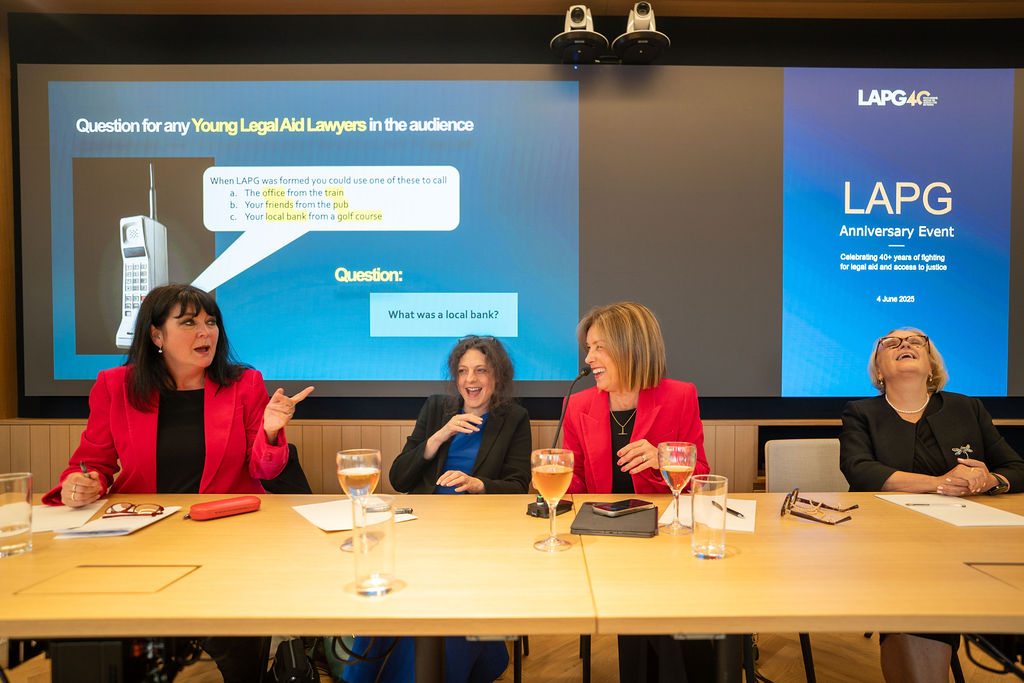
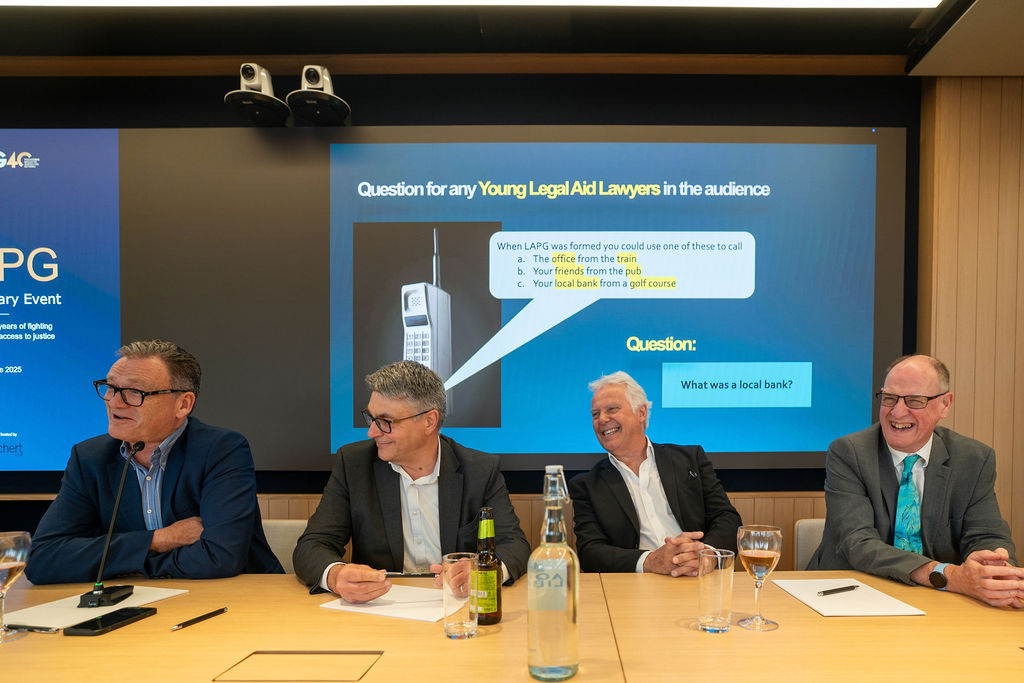







Thank you Richard Gray for capturing a wonderful evening celebrating our 40-ish Anniversary